Why There Is Current on a Water Main Grounding Electrode
Updated: Jan 24
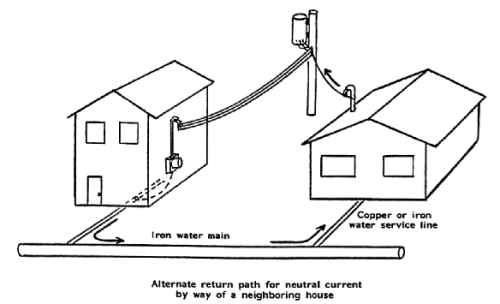
If you’ve ever measured voltage or current on a metal water main and wondered “Why is there electricity on my plumbing?”—you’re not alone. This is a common and often misunderstood phenomenon in electrical systems. The presence of current on a water main grounding electrode is usually intentional, expected, and necessary for safety.
Let’s break down why it happens, what it means, and when it may indicate a problem.
What Is a Water Main Grounding Electrode?
In many electrical systems, especially in residential and light commercial buildings, the metal underground water pipe is used as part of the grounding electrode system.
Because buried metal water pipes:
Have long contact with the earth
Provide low resistance to ground
Are electrically continuous
…they make an excellent path for grounding electrical systems.
Electrical codes (such as the NEC in the U.S.) often require metal water piping to be bonded and, when qualifying, used as a grounding electrode.
Why Is There Current on the Water Main?
1. Normal Neutral Return Current
In most electrical systems, the neutral conductor is bonded to ground at one location (typically the main service disconnect). When loads are operating:
Current flows from the hot conductor
Through electrical loads
Returns on the neutral
Because the neutral and grounding system are bonded, some current can divide and flow through bonded metal parts, including:
Water mains
Metal piping
Building steel
This is called objectionable but permitted parallel current, and in small amounts, it is normal.
2. Bonding Equalizes Voltage
The purpose of bonding the water main is not to carry current, but to:
Keep all metal parts at the same electrical potential
Prevent shock hazards
Ensure fault current has a low-impedance return path
When electrical loads turn on and off, slight voltage differences occur. Bonding allows small currents to flow so those differences are equalized.
Without this bonding, you could have:
Energized pipes
Shock risk between plumbing and appliances
Dangerous fault conditions
3. Fault Current Path During Electrical Faults
In the event of a fault—such as a hot conductor contacting metal equipment—the water main grounding electrode may carry significant current temporarily.
This is a critical safety function:
The fault current flows rapidly
Circuit breakers trip
The dangerous condition is cleared
In these moments, seeing current on the water main is not a failure—it’s the system doing its job.
4. Parallel Grounding Paths in Modern Systems
Modern buildings often have multiple grounding paths:
Ground rods
Water mains
Concrete-encased electrodes (Ufer grounds)
Structural steel
Current naturally divides among all available paths according to resistance. The water main is simply one of many parallel conductors.
When Is Current on a Water Main a Concern?
While some current is normal, excessive or continuous current may indicate a problem, such as:
Loose or broken neutral conductor
Improper neutral-to-ground bonding downstream
Shared neutrals between buildings
Utility-side neutral issues
Missing or damaged bonding jumpers
Warning signs include:
Tingling or shocks from faucets
Measurable voltage between pipes and ground
Corrosion or pitting of pipes (electrolysis)
Warm bonding conductors
These situations should be evaluated by a qualified electrician or utility provider.
Why Plastic Pipes Change the Equation
As metal water mains are replaced with plastic (PVC, PEX), their grounding effectiveness disappears. This is why:
Supplemental grounding electrodes are required
Bonding jumpers are installed around meters
Electrical codes have evolved to require multiple electrodes
Plastic pipes cannot carry grounding current, making proper grounding design even more critical.
Final Thoughts
The presence of current on a water main grounding electrode is usually:
Normal
Intentional
Essential for safety
Grounding and bonding systems are designed to manage electrical energy safely—not eliminate it entirely. Understanding this helps reduce confusion and ensures that true hazards are identified correctly.
If you suspect abnormal current levels or experience shocks, don’t ignore it—have the system inspected.


Comments